Introduction
Every student's educational path has a few key milestones, and one of the major ones comes at the end of Class 10. It is when life in school starts making way for actual academic specialisation, and it is known as pre-university education.
Have you ever come across the terms PUC, Intermediate, +2, and been confused about their significance? In this article, we will learn about the significance of pre university education, the various streams that one can choose from and how this education forms the base for their career. If you are a student, parent or simply interested in learning about pre university education, then read on!
What Is Pre-University Education?
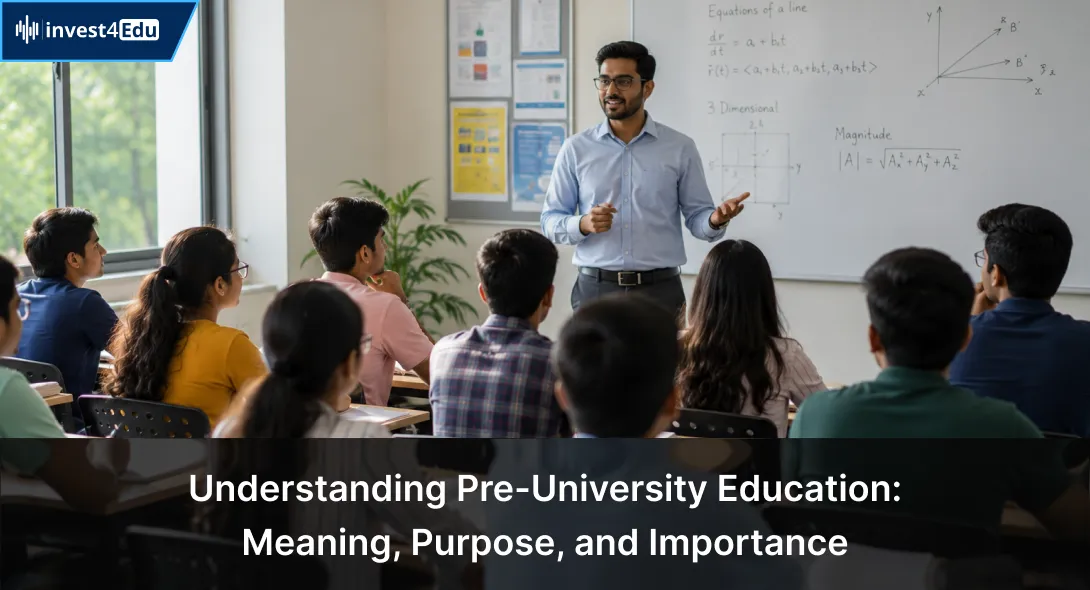
Pre-university education is the term used to describe the educational level that comes right after high school (Class 10) and before an undergraduate course. In India, pre-university education is called PUC (Pre-University Course), intermediate, or +2, depending upon the state and education board.
The two-year educational program, which includes Class 11 and Class 12, has three purposes:
- Enriching knowledge of the subjects beyond the basic knowledge acquired in school.
- Specialising or opting for a specific stream according to the interest of the student.
- Preparation for entrance examinations and admission into universities.
To put in a nutshell, the pre-university education is the link between general education and specialisation in higher education.
Why Pre-University Education Is Important?
Pre-University education is far more than preparing students for Board exams. The education received here forms the basis for advanced studies and assists students in making informed decisions regarding their career paths.
|
Why It Matters |
How It Helps Students |
|
Builds subject expertise |
Develops a deeper understanding of chosen subjects. |
|
Prepares for entrance exams |
Includes topics needed for JEE, NEET, CUET, CLAT and other entrance exams. |
|
Supports career planning |
Allows students to discover possible career paths before opting for a course. |
|
Develops essential skills |
Enhances analytical, communication, research and problem solving skills. |
|
Creates higher education opportunities |
Creates paths for undergraduate and professional courses. |
Often, the knowledge and study skills acquired during these two years affect a student's future performance and decision-making regarding their career.
How Pre-University Education Works in India
In India, there is the education system which follows the 10+2+3 format where the candidates first undergo ten years of schooling before taking two years of pre-university studies before pursuing undergraduate education.
The students decide which stream they want to follow after they complete their class 10 according to their future plans and then they will take up certain subjects for two years to clear the board exams in order to pursue their further studies.
How the journey works
Class 10
↓
Choose a Stream
↓
Class 11 & 12 (Pre-University Education)
↓
Board Examinations
↓
Higher Education
Programme Names Across India
Though the program goes by many names across the country, the objective of it stays the same. It acts as a link from secondary to higher education and prepares the students for college life and their careers.
|
State/Board |
Programme Name |
|
Karnataka |
Pre-University Course (PUC) |
|
Andhra Pradesh |
Intermediate |
|
Telangana |
Intermediate |
|
Tamil Nadu |
Higher Secondary |
|
Maharashtra |
Higher Secondary Certificate (HSC) |
|
Kerala |
Higher Secondary Education |
|
CBSE |
Senior Secondary (Class 11–12) |
|
CISCE |
ISC (Class 11–12) |
Streams Available in Pre-University Education
Among the most important considerations that must be made after Class 10, the selection of the proper stream becomes the first. A proper stream must be chosen according to the interest of the individual and not because it is popular among his or her friends.
Science
The stream of Science becomes an appropriate option for those interested in pursuing a career in engineering, medicine, research, technologies, and other fields connected with science.
|
Particulars |
Details |
|
You will Study |
Physics, Chemistry, Mathematics, Biology, Computer Science and English |
|
Career Paths |
Engineering, Medicine, Pharmacy, Architecture, Data Science and Research |
|
After Class 12, you can choose |
BTech, MBBS, BDS, BSc, BPharm, BArch and BCA |
Want to explore your options after choosing the Science stream?
Read our detailed guide on Top Career Options After 12th Science to find out popular degree programmes, emerging careers, and the skills needed to succeed.
Commerce
Commerce is best suited for students who are interested in pursuing their careers in the fields of business, finance, economics, and accounting.
|
Particulars |
Details |
|
You will Study |
Accountancy, Business Studies, Economics, Mathematics, Statistics and English |
|
Career Paths |
Chartered Accountant, Financial Analyst, Banker, Entrepreneur and Marketing Professional |
|
After Class 12, you can choose |
BCom, BBA, BMS, CA, CS and CMA |
The Commerce stream offers exciting opportunities in finance, business, accounting, marketing, and entrepreneurship. Explore the best courses and career options in our guide to Top Career Options After 12th Commerce.
Arts/Humanities
Arts/Humanities is all about studying human behaviour, society, cultures, governance and communication. This stream opens up many different career options in the government sector as well as the private sector.
|
Particulars |
Details |
|
You will Study |
History, Geography, Political Science, Psychology, Sociology, Economics and English |
|
Career Paths |
Lawyer, Civil Servant, Journalist, Teacher, Psychologist and Public Relations Professional |
|
After Class 12, you can choose |
BA, BA LLB, BJMC, BSW, BA Psychology and Public Administration |
Thinking about a career after choosing the Arts stream?Explore the best courses, career opportunities, and higher education options in our detailed guide on Top Career Options After 12th Arts.
Vocational Streams
Vocational Education is all about learning in the class room as well as gaining practical skills and getting students prepared for jobs, while at the same time providing scope for higher studies.
|
Particulars |
Details |
|
You will Study |
Information Technology, Healthcare, Hospitality, Agriculture, Retail and Electronics |
|
Career Paths |
IT Support Executive, Hospitality Professional, Technician, Healthcare Assistant and Retail Manager |
|
After Class 12, you can choose |
BVoc programmes, Diploma courses, Skill Development programmes and Industry Certifications |
Pre-University Education vs Higher Education
Pre-university education is generally mistaken as higher education, but both of these play different roles. The role of pre-university education lies in the fact that it helps to prepare the students academically for higher education as well as assists them to select an appropriate stream. Whereas higher education starts right after Class 12th and deals with specialised degree courses and professional education.
|
Feature |
Pre-University Education |
Higher Education |
|
Academic Stage |
After Class 10 |
After Class 12 |
|
Duration |
2 Years |
3–5 Years or more |
|
Focus |
Academic foundation and stream selection |
Professional and specialised education |
|
Learning Style |
Classroom learning, practicals, board exams |
Lectures, projects, research, internships |
|
Outcome |
Eligibility for undergraduate studies |
Degree, diploma or professional qualification |
How to Choose the Right Stream in Pre-University Education
Selecting the correct stream is one of the most important academic decisions you will make. Instead of trying to follow trends or peer pressure, select the stream that fits your needs and goals. It may be quite confusing to choose a stream, but here are a few considerations when selecting a stream:
- Interests and abilities: Opt for courses you have passion for and wan to excel in and not merely based on their prestige.
- Career plans: If you have a plan for your future career, then do things in reverse order and check what stream/subjects you require.
- Previous academic strengths: Experience in particular disciplines, such as Maths or Science can be a factor, but not the sole one.
- Prospects: Certain streams offer greater flexibility to change the subject in future while others specialise in their field straight away.
- Self-realistic assessment of abilities: Be realistic and consider how much you like doing theoretical homework or rote learning.
Important point to note : Ultimately, there is no universal best stream; the ideal choice depends entirely on the student.
Before choosing a stream, ask yourself:
✔ Which subjects do I enjoy the most?
✔ What are my strengths?
✔ Which careers interest me?
✔ Does my preferred career require specific subjects?
✔ Have I spoken to teachers or career counsellors?
Note : The right stream is the one that aligns with your interests, aptitude, and long-term career aspirations—not the most popular one.
Role of Career Counselling Before Choosing a Pre-University Stream
The selection of the pre-university stream is a critical decision made by the students early in their academic journey and one whose effects may resonate way beyond the 12th class. Given the importance of the decision for further studies and career, getting professional career counselling before making the decision can prove extremely useful.
Career counselling can prove beneficial to both students and parents in:
- Understanding the aptitude, interests, personality, and strengths of a student through scientifically designed psychometric tests.
- Matching the career goals with the right stream and subjects.
- Clearing common misconceptions, such as Arts being an "easy" option or Commerce being suitable only for students who don't choose Science.
- Reducing confusion and anxiety in both the students and parents.
- Understanding new career avenues and industry trends.
invest4Edu provides career counselling tailored to individual needs of each student through counselling sessions and psychometric assessments that are required for understanding the abilities, interests, personality, and mode of learning of the student. Based on that, the experts in career counselling will give advice about the appropriate stream according to the abilities and interest and future career plans.
In this way, students don’t have to succumb to peer pressure, family pressure, or any other trend but rather make sound and informed choices based on their choice.
What Comes After Pre-University Education?
Finishing pre-university education provides the way to various ways of education in the higher studies. What options can be taken depend upon the stream chosen, performance in the pre-university, and the career goals.
|
Next Step |
Examples |
|
Undergraduate Degrees |
BTech, MBBS, BCom, BA, BSc, BBA, BCA |
|
Professional Courses |
CA, CS, CMA, Hotel Management, Aviation |
|
Entrance Examinations |
JEE, NEET, CUET, CLAT, NIFT, NDA |
|
Skill-Based Programmes |
BVoc, Diploma Courses, Industry Certifications |
There are also other options such as pursuing integrated courses or study overseas or specialised professional courses according to the choice and eligibility of the students.
Conclusion
Pre-university education is a key stage between secondary and higher education. This is the stage where the student will specialise for the very first time in his/her life, lay foundations for entrance exams and degrees, and also for the future professional path. The proper selection of stream and the awareness of its aim can facilitate the process greatly and ensure its much greater efficiency, preparing one not only to pass the test, but to enter a desired educational establishment and career track.