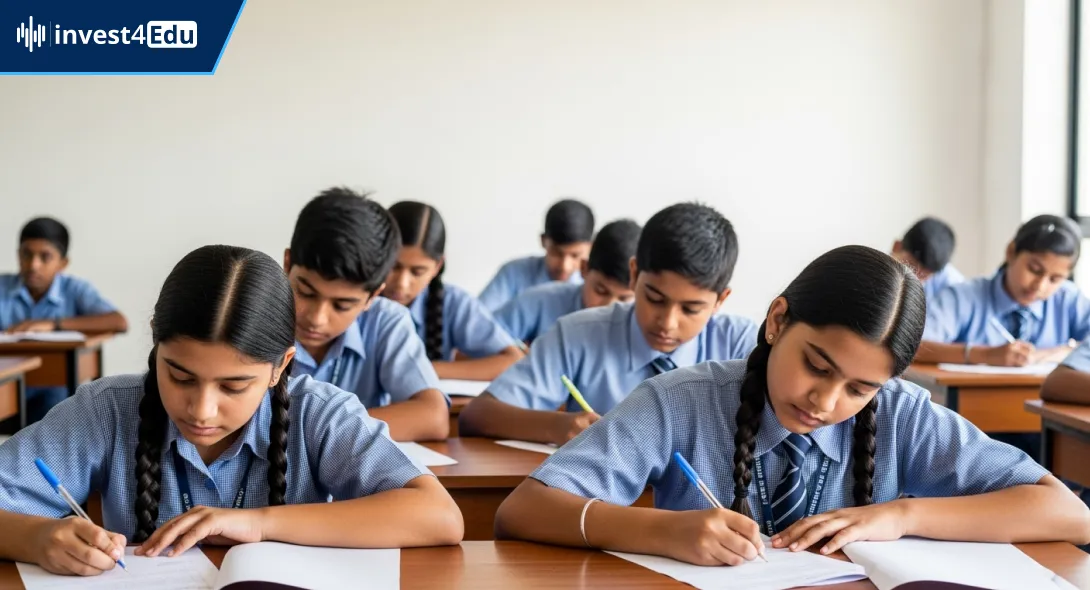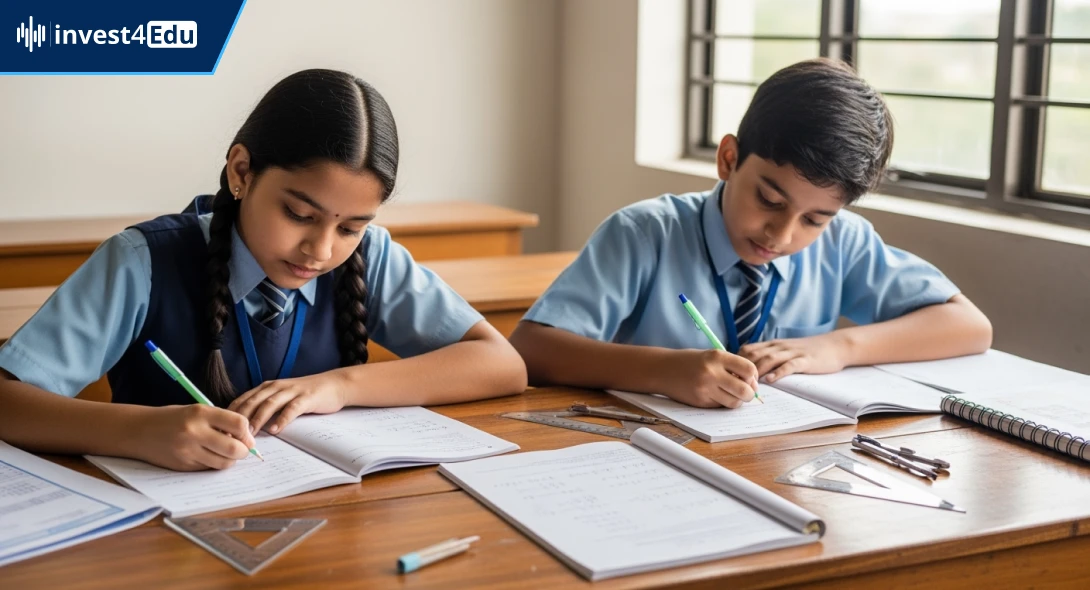
Mathematics is often called the language of logic, and the Maths Olympiad Exam is one of the highly regarded competitive exams that test and nurture mathematical skills among students. These exams are not just about solving equations; they are about skill-building, such as thinking critically, applying maths concepts creatively, and developing problem-solving abilities that go beyond the classroom. Every year, lakhs of students across India and the world participate in Maths Olympiads to challenge themselves, compete with the brightest minds, and build a strong foundation for future academic and professional success.
In this blog, we are going to cover everything about the Maths Olympiad 2025 — from exam levels, dates, and participation process to benefits and preparation tips.
What is Maths Olympiad?
The Maths Olympiad is a competitive examination conducted at school, national, and international levels to identify and encourage mathematical talent among students from Class 1 to 12. Unlike regular school exams, which focus mainly on theory and textbook-based questions, the Maths Olympiad challenges students with application-based problems, logical reasoning, and higher-order thinking questions.
Maths Olympiad 2025 Exams
The year 2025 will witness multiple Olympiad exams conducted by various educational organisations. Each Olympiad body has its own syllabus, exam pattern, and rewards, but the aim remains the same – to help students develop mathematical confidence and logical reasoning.
These exams are conducted at different levels:
- School / National Level – Competitions are held within the country to identify and reward talented students across schools and regions.
- International Level – Top-performing students advance to represent their country in global competitions such as the International Mathematics Olympiad (IMO).
It is organised by reputed educational foundations such as:
- SOF (Science Olympiad Foundation) – International Mathematics Olympiad (IMO)
- Indian Talent Olympiad (ITO) – International Maths Olympiad
- SilverZone Foundation – International Olympiad of Mathematics (IOM)
- Unified Council – Unified International Mathematics Olympiad (UIMO)
Maths Olympiad 2025 Exams at the National Level
The Maths Olympiad 2025 at the national level is the stepping stone for students before they qualify for international rounds. At this stage, students from different schools and boards across India compete with each other to showcase their mathematical skills and logical ability. These exams provide exposure to a wider level of competition while still being based on the student’s school curriculum.
Key Features of National Level Olympiads
- Eligibility: Open to all students from Class 1 to 12 across CBSE, ICSE, and State Boards.
- Syllabus: Based on school curriculum but framed in a way that encourages application, reasoning, and higher-order thinking.
- Mode of Exam: Conducted both online and offline, depending on the organiser and school preference.
- Question Pattern: Objective-type (MCQs) with sections covering Logical Reasoning, Mathematical Reasoning, Everyday Maths, and Achievers Section.
- Recognition: Winners at the national level are awarded medals, certificates, scholarships, and also get the chance to compete at international Olympiads.
Major National Level Maths Olympiads in 2025
Several reputed organisations conduct maths Olympiads at the national level in India. Some of the most popular include:
|
Organisation |
Exam Name |
Classes Eligible |
Highlights |
|
SOF (Science Olympiad Foundation) |
International Mathematics Olympiad (IMO) – Level 1 |
Classes 1–12 |
Widely recognised, conducted in schools across India. |
|
Indian Talent Olympiad (ITO) |
National Mathematics Olympiad |
Classes 1–10 |
Monthly and annual Olympiads with attractive prizes. |
|
Unified Council |
Unified International Mathematics Olympiad (UIMO) – National Stage |
Classes 1–12 |
Focuses on conceptual learning and application. |
|
SilverZone Foundation |
International Olympiad of Mathematics (IOM) – National Round |
Classes 1–12 |
Provides international exposure while starting at the national level. |
International Level Maths Olympiad Exam
After excelling at the national level, top-performing students get the opportunity to represent India at the International Level Maths Olympiad. This is the most prestigious stage of the Olympiad journey, where young mathematicians from across the globe compete, collaborate, and showcase their talent on an international platform.
Key Highlights of International Maths Olympiad
The International Maths Olympiad 2025 stands out as one of the most prestigious academic competitions in the world, offering students a platform to prove their mathematical excellence on a global stage.
- Global Participation: Students from 100+ countries take part, making it one of the largest student competitions internationally.
- Selection Process: Only the top performers from national-level Olympiads qualify to represent their countries, ensuring the best of the best compete.
- Advanced Difficulty: The exam features higher-order thinking, creative, and application-based problems designed to test innovative approaches to mathematics.
- Prestige & Recognition: Winners are honoured with gold, silver, and bronze medals, scholarships, merit certificates, and global recognition.
- Competing with the Best: Participants get the rare opportunity to challenge themselves alongside the brightest mathematical minds from across the globe.
- Academic Value: Representing India at an international Olympiad significantly enhances a student’s academic profile.
- Profile Enhancement: It enhances college and university applications, particularly in STEM fields, improves prospects for studying abroad, and adds lasting value to a student’s career path.
Major International Maths Olympiads for School Students
While the IMO (International Mathematics Olympiad by SOF) is the most popular among Indian students, several other international competitions are equally prestigious:
|
Olympiad Name |
Organiser |
Eligibility |
Focus Area |
|
International Mathematics Olympiad (IMO) |
SOF (Science Olympiad Foundation) |
Classes 1–12 |
Reasoning, problem-solving, logical application of maths. |
|
International Mathematical Olympiad (Global IMO) |
International Board (host country changes every year) |
High school students (usually Classes 11–12) |
Advanced-level mathematics, theory, and problem-solving. |
|
International Olympiad of Mathematics (IOM) |
SilverZone Foundation |
Classes 1–12 |
Conceptual understanding with an international framework. |
|
Asian Mathematical Olympiad (AMO) |
Regional body |
Middle and high school students |
Focus on problem-solving and mathematical creativity. |
Maths Olympiad 2025 – Important Dates and Events
The Maths Olympiad 2025 will be conducted at different times depending on the organising body, such as SOF (Science Olympiad Foundation), Indian Talent Olympiad (ITO), SilverZone Foundation, and Unified Council. While exact dates may vary, the overall timeline of registration, exams, and results follows a similar pattern.
While each Olympiad body announces its own calendar, here’s a general timeline for 2025:
- School & Individual Registrations: June–July 2025
- Level 1 Exams (School/National Level): October–December 2025
- Level 2 Exams (Qualified Students): January–February 2026
- Result Declaration: Within 6–8 weeks after the exam
|
Particulars |
Tentative Months (2025–26) |
Details |
|
School & Individual Registrations Open |
June – July 2025 |
Schools and individual students can register through official Olympiad websites. |
|
Last Date for Registration |
August – September 2025 |
Final deadline differs by organiser; early registration is recommended. |
|
Level 1 Exam (School/National Level) |
October – December 2025 |
Conducted in both online and offline mode; open for all Classes 1–12. |
|
Results of Level 1 |
December 2025 – January 2026 |
Results are announced within 6–8 weeks after the exam. |
|
Level 2 Exam (International Level) |
January – February 2026 |
For top scorers from Level 1; focuses on higher-order problem-solving. |
|
Declaration of Final Results |
March – April 2026 |
Winners are awarded medals, certificates, and scholarships. |
Different Mathematics Olympiad Exams Dates
Mathematics Olympiads are conducted throughout the year, giving students multiple opportunities to participate and showcase their problem-solving skills. The table below provides the tentative dates for major national and international-level maths Olympiads in 2025–26:
|
Different Maths Olympiad Exam |
Exam Date(s) |
|
SOF IMO – Level 1 |
12 Nov, 28 Nov, 12 Dec 2025 |
|
SOF IMO – Level 2 |
January 2026 |
|
SilverZone IOM – Level 1 |
19 Nov & 16 Dec 2025 |
|
ITO IMO – Online (Round 1) |
6 Dec 2025 & 10 Jan 2026 |
|
ITO IMO – Offline |
17–22 Nov 2025 |
|
IOQM (Indian Olympiad Qualifier in Maths) |
7 Sep 2025 |
|
RMO (Regional Mathematical Olympiad) |
9 Nov 2025 |
|
INMO (Indian National Mathematical Olympiad) |
18 Jan 2026 |
|
International Mathematical Olympiad (IMO 2025) |
10–20 Jul 2025 |
Detailed Maths Syllabus for National & International Olympiads
The Maths Olympiad syllabus for both national and international levels is carefully designed to test conceptual clarity, logical reasoning, and application-based problem-solving skills. While the core concepts are aligned with school curriculum, the difficulty level gradually increases to match global Olympiad standards.
1. SOF – International Mathematics Olympiad (IMO)
The syllabus aligns with CBSE/ICSE/State Board curricula and is enriched with reasoning and problem-solving layers:
- Classes 1–4: Logical reasoning, number sense, everyday mathematics, basic geometry (shapes, mirror images, time, patterns), and an Achievers' Section for advanced thinking.
- Classes 5–10: Logical reasoning, mathematical reasoning, everyday mathematics, and an advanced Achievers' Section. Topics include operations, fractions, conversions, measurement, and data handling.
- Classes 11–12: Sets, functions, sequence & series, algebra (logarithms, complex numbers, inequalities), calculus basics (limits, derivatives), statistics, and 3-D geometry.
2. SilverZone – International Olympiad of Mathematics (IOM)
The syllabus follows board-level maths with logical and analytical emphasis, evolving in difficulty for higher classes:
- Classes 1–5: Numbers, fractions, basic geometry, measurement, data handling, and reasoning, with a Scholar’s Section for deeper skills.
- Classes 6–8: Arithmetic, algebra basics, geometry, data interpretation, logical reasoning, and scholarly problem-solving.
- Classes 9–10: Algebra, trigonometry, coordinate geometry, data handling, and reasoning.
- Classes 11–12: Calculus basics, vectors, advanced algebra, statistics, and probability.
3. Indian Talent Olympiad (ITO – IMO)
The syllabus broadly follows school curriculum while adding Olympiad depth:
- Number systems, algebra, geometry, data handling, logical reasoning, and higher-order thinking tailored by class.
4. HBCSE – IOQM, RMO & INMO (Pathway to Global IMO)
- IOQM (Qualifier; Class 8–12):
Algebra, number theory, combinatorics, geometry beyond school curriculum. Paper is 3 hours with 30 integer-type problems. - RMO (Regional Round):
Subjective problems across algebra, combinatorics, geometry, and number theory. - INMO (National Round):
6 challenging subjective problems in 4.5 hours. Focused on algebra, geometry, combinatorics, and number theory. Top performers enter the Mathematical Olympiad Program (MOP).
5. Global International Mathematical Olympiad (IMO)
The world’s most prestigious school-level competition:
- No fixed syllabus; problems test algebra, number theory, geometry, and combinatorics.
- Format: Two consecutive days, three problems each day (4.5 hours/day), each worth 7 marks (total 42).
|
Olympiad |
Class Level |
Key Topics |
|
SOF IMO |
1–12 |
School syllabus + reasoning, algebra, geometry, calculus (11–12) |
|
SilverZone IOM |
1–12 |
School maths + reasoning, logic, higher thinkers |
|
ITO IMO |
1–10 |
Standard maths + algebra, geometry, data, reasoning |
|
IOQM → RMO → INMO → IMO |
8–12 (advanced) |
Algebra, geometry, combinatorics, number theory |
|
Global IMO |
Pre-University |
Creative algebra, number theory, combinatorics, geometry (high difficulty) |
Class-Wise Maths Olympiad Topic Checklist (1–12)
This checklist helps students systematically prepare for mathematics Olympiads by covering all essential topics for their respective classes. The list below gives the complete details of topics from Class 1 to Class 12, ensuring thorough preparation for both national and international-level exams:
Classes 1–2
- Numbers and Number Sense: Counting, place value, odd/even numbers
- Basic Addition & Subtraction
- Shapes & Geometry: Lines, angles, basic 2D shapes
- Patterns & Sequences
- Time & Calendar
- Logical Reasoning & Puzzles
Classes 3–5
- Multiplication & Division, Fractions & Decimals
- Measurement: Length, weight, capacity, perimeter
- Geometry: Triangles, quadrilaterals, symmetry
- Data Handling: Tables, pictographs, bar graphs
- Mental Maths & Problem Solving
- Logical Reasoning & Analytical Puzzles
Classes 6–8
- Number Systems: Integers, fractions, decimals, factors, multiples
- Algebra: Simple equations, patterns, expressions
- Geometry: Circles, polygons, angles, coordinate geometry basics
- Data Handling: Charts, probability basics
- Mensuration: Area, volume, surface area
- Logical Reasoning & Higher-Order Problems
Classes 9–10
- Algebra: Quadratic equations, inequalities, sequences
- Geometry: Triangles, circles, coordinate geometry, trigonometry basics
- Number Theory: Divisibility, HCF, LCM, primes
- Probability & Statistics
- Mensuration & Advanced Problem Solving
- Logical Reasoning & Puzzles
Classes 11–12
- Algebra: Complex numbers, logarithms, inequalities, sequences & series
- Calculus Basics: Limits, derivatives, simple integrals
- Coordinate Geometry & Vectors
- Trigonometry & Advanced Geometry
- Probability & Statistics
- Logical Reasoning & Olympiad-Level Problem Solving
Advanced Olympiad Track (IOQM → RMO → INMO → Global IMO)
- Algebra: Polynomials, functional equations, inequalities
- Number Theory: Divisibility, modular arithmetic, primes, remainders
- Geometry: Triangles, circles, 3D geometry, coordinate geometry
- Combinatorics: Permutations, combinations, counting problems
- Advanced Problem Solving & Logical Reasoning
Know the Exam Pattern
Before starting preparation, it is important for students to understand the exam pattern thoroughly. The Maths Olympiad follows a structured format that usually includes multiple-choice questions (MCQs) designed to test conceptual knowledge, logical reasoning, and problem-solving ability.
- Number of Questions: Depending on the organiser and class level, the paper generally consists of 30 to 50 questions.
- Sections: Most Olympiads divide the paper into sections such as Mathematical Reasoning, Logical Reasoning, Everyday Maths, and Achievers’ Section.
- Marking Scheme: Questions carry varying marks. For example, in SOF IMO, standard questions carry 1 mark each, while Achievers’ Section questions carry higher marks (e.g., 3–4 marks each).
- Difficulty Levels: The paper is usually set at three levels of difficulty – easy (to test basics), moderate (to test application), and advanced (to test analytical problem-solving).
- Duration: The exam duration is typically 60 to 90 minutes, depending on the class and exam organiser.
Maths Olympiad Exam Pattern (Class-Wise)
|
Class Group |
No. of Questions |
Marks per Question |
Total Marks |
Time Duration |
Difficulty Level |
|
Class 1 – 4 |
35 |
1 mark each |
35 |
60 minutes |
Basic (concepts & reasoning) |
|
Class 5 – 8 |
50 |
1 mark each |
50 |
60 minutes |
Moderate (application-based) |
|
Class 9 – 12 |
60 |
1 mark each |
60 |
60 minutes |
Advanced (higher-order thinking & problem-solving) |
Note: The exact number of questions and marks may vary slightly depending on the organising body (SOF, ITO, SilverZone, etc.), but the above structure is commonly followed.
Maths Olympiad Exam Pattern Comparison (SOF, SilverZone, ITO)
Here’s a comparison table of exam patterns for the major Maths Olympiad organisers, giving students and parents a clear idea of eligibility, question format, marking scheme, and difficulty levels so they can plan their preparation more effectively.
|
Exam Body |
Classes Eligible |
No. of Questions |
Duration |
Sections |
Marking Scheme |
Difficulty Level |
|
SOF International Maths Olympiad (IMO) |
1 – 12 |
35- (Classes 1–4), |
60 minutes |
Logical Reasoning, Mathematical Reasoning, Everyday Maths, Achievers’ Section |
1 mark (Std Qs), 3–4 marks (Achievers’ Qs) |
Easy → Moderate → Advanced |
|
SilverZone International Olympiad of Mathematics (IOM) |
1 – 12 |
40 (Classes 1–2), 50 (Classes 3–12) |
60 minutes |
Mathematics & Reasoning |
1 mark per correct answer |
Increasing difficulty with grade |
|
Indian Talent Olympiad (ITO – IMO) |
1 – 10 |
25 (Classes 1–4), 30 (Classes 5–10) |
25–40 minutes |
Mathematical Reasoning, Logical Reasoning, Higher Order Thinking |
1 mark per question |
Easy → Moderate |
|
Unified Council (UIMO) |
1 – 12 |
35 (Classes 1–4), 50 (Classes 5–12) |
60 minutes |
Mathematical Reasoning, Logical Skills, Critical Thinking |
1–4 marks depending on section |
Mixed (Concept + Application) |
Benefits of Maths Olympiad
The benefits of participating in Maths Olympiads extend far beyond winning medals.The Olympiads train the brain for success, making students smarter, sharper, and more confident. Here’s why every student should consider taking part:
- Stronger Concepts: Builds a solid foundation in mathematics beyond textbooks, ensuring clarity in fundamentals that help in advanced learning.
- Critical Thinking: Improves logical reasoning and problem-solving ability, making students approach challenges with creativity and accuracy.
- Boosts Confidence: Enhances self-belief and develops a healthy competitive spirit, motivating students to take on bigger academic goals.
- Better Academics: Prepares students for school exams and future entrance tests like JEE, NEET, and SAT by sharpening analytical skills.
- Recognition & Rewards: Certificates, medals, and scholarships add value to profiles, giving students an edge in admissions and scholarships.
- Career Readiness: Develops skills useful in engineering, research, finance, and tech, laying the groundwork for future career success.
- Global Exposure: Opportunity to represent India and compete internationally, opening doors to global study and career opportunities.
Who Can Participate in Mathematics Olympiad Exam?
The Mathematics Olympiad is open to a wide range of students, making it one of the most inclusive academic competitions.
- Eligibility: Students from Class 1 to 12 studying in CBSE, ICSE, IB, or State Board schools can participate.
- School Participation: Both government and private school students are eligible.
- Individual Applicants: Even if a school is not registered, students can apply individually online through official Olympiad websites.
- International Students: Students from other countries can also take part in international-level Olympiads.
- No Prior Qualification Needed: Any student interested in maths, problem-solving, and logical reasoning can register—no previous Olympiad experience is required.
How to Register in Mathematics Olympiad Exam
Registering for the Maths Olympiad is simple. Students can apply either through their schools or via direct online registration on the official Olympiad websites.
Steps to Register:
- Select the Olympiad : Choose the organisation (SOF, Indian Talent Olympiad, SilverZone, Unified Council, etc.) conducting the exam you want to appear for.
- Check Eligibility : Open for students from Class 1 to 12, across all boards (CBSE, ICSE, State Boards).
- Get the Registration Form: Individual applicants can register directly online through the official website, while schools circulate forms provided by the Olympiad bodies.
- Fill in Student Details : Provide student’s name, class, school details, and preferred exam mode (online/offline).
- Pay the Registration Fee : Nominal fee (₹125–₹200 approx. per subject), payable online or via the school.
- Confirmation & Admit Card : After successful registration, students receive confirmation and admit cards with exam date and centre details.
- Access Study Resources : Sample papers, syllabus, and preparation guides are often provided by the Olympiad body to registered students.
How to Prepare for Maths Olympiad
Preparing for the Maths Olympiad requires focus, consistency, and the right strategy. Here are some effective tips:
- Understand the Syllabus : Go through the Olympiad syllabus (based on school curriculum – CBSE, ICSE, or State boards) and note the important topics.
- Strengthen Concepts: Focus on clarity of basic concepts in arithmetic, algebra, geometry, and logical reasoning.
- Practise with Sample Papers : Solve previous years’ question papers and mock tests to get familiar with the exam pattern.
- Use Olympiad Books & Guides : Refer to specialised Olympiad preparation books and online resources for practice.
- Work on Logical Reasoning : Olympiads test not just maths but also reasoning. Practise puzzles, riddles, and logical questions regularly.
- Take Mock Tests : Attempt online and offline mock exams to build exam temperament and improve speed.
- Seek Guidance : Join Olympiad coaching classes, online courses, or ask teachers/mentors for support if needed.
Tips to Achieve Success in Maths Olympiad Exams
Success in the Maths Olympiad comes with smart preparation and disciplined practice. Here are some practical tips every student should follow:
- Start Early Preparation : Begin at least 3–6 months in advance to cover the syllabus thoroughly.
- Know the Exam Pattern: Understand the marking scheme, number of questions, and difficulty levels. This helps in smart preparation.
- Focus on Core Concepts : Instead of memorising formulas, learn the “why” behind mathematical principles.
- Daily Practice : Dedicate at least 30–60 minutes daily for problem-solving and reasoning practice.
- Solve Previous Papers : Past question papers give insights into frequently asked topics and exam trends.
- Improve Speed & Accuracy: Practise under timed conditions to manage time better in the exam.
- Strengthen Weak Areas: Identify topics you find difficult and give them extra practice instead of avoiding them.
- Use Quality Study Material : Rely on Olympiad books, online practice tests, and mock exams to prepare effectively.
- Think Logically : Olympiads test reasoning as much as mathematics, so practise puzzles, riddles, and brain teasers.
- Stay Consistent & Organised : Follow a study timetable and regularly revise instead of cramming at the last moment.
- Stay Positive & Confident : A calm and confident approach in the exam hall is as important as preparation.
Maths Monthly Olympiads
To help students stay consistent, many organisations now conduct Monthly Olympiads. These are short-format online tests held every month, designed to keep students in touch with concepts throughout the year.
Why Monthly Olympiads are Useful:
- Provide continuous practice.
- Identify weak areas early.
- Improve time management and problem-solving speed.
- Keep students motivated and exam-ready.
- Monthly Olympiads act like regular practice matches, preparing students for the main annual Olympiad exams.
How invest4Edu Supports Maths Olympiad Preparation
At invest4Edu, we provide comprehensive support for students preparing for Maths Olympiad exams. Our services combine academic guidance, strategic planning, and career support to ensure a well-rounded preparation.
- Personalised Education Planning: We design customised learning plans that focus on each student’s strengths and areas for improvement, keeping them on track for success.
- Psychometric Assessments: Our psychometric tests identify students’ natural strengths and interests, helping us tailor preparation strategies for optimal performance.
- Financial Planning & Scholarships: We guide families with financial planning tools and provide information on scholarships and aid, ensuring students have the resources needed to participate confidently.
- Career Guidance: Our career counselling helps students understand the long-term benefits of excelling in Maths Olympiads, motivating them to pursue mathematics and related fields with confidence.
Conclusion
The Maths Olympiad 2025 is a remarkable platform for students to strengthen their mathematical skills, boost intellectual growth, and build confidence. It offers opportunities for recognition at both national and international levels, whether through monthly Olympiads or global competitions. Each stage encourages students to challenge themselves, learn, and excel. With effective preparation, students can unlock their full potential in mathematics, paving the way for a bright academic future. invest4Edu provides expert support and personalised guidance, ensuring every student is fully equipped to succeed in the Maths Olympiad and beyond.